

Badging Is Not About Time Tracking Anymore. It’s About Cybersecurity.
Badging Is Not About Time Tracking Anymore. It’s About Cybersecurity.
For years, badging has been seen as an HR tool.
A way to record when employees start working, when they stop, and whether their working hours match expectations.
Useful? Yes.
Cybersecurity-grade? Not usually.
But OpenOTP Mobile Badging changes that.
This is not a badge that opens doors.
This is a phone-based security signal that tells your identity system something far more important:
Is this user actually active, authorized, and in the right context to access company resources right now?
With a mobile badging app, the user’s phone becomes part of the access decision.
Location, device trust, working status, network context, and authentication policy can all work together to reduce the attack surface, eliminate shared passwords, strengthen Zero Trust, reduce unnecessary MFA prompts, and dynamically adapt access rights.
Welcome to the next generation of cybersecurity.
Welcome to mobile badging as a security control.
The Biggest Security Problem Nobody Talks About
Organizations spend millions on cybersecurity technologies.
- Firewalls
- EDR
- SIEM
- MFA
- VPNs
- Threat intelligence
Yet one of the most dangerous security questions often remains unanswered:
“Should this user actually have access right now?”
Most identity systems assume that once credentials are issued, access remains available 24/7.
- A user leaves the office at 6 PM.
- Their credentials remain active.
- Their VPN access remains active.
- Their workstation credentials remain active.
- Their privileged accounts remain active.
- The attack surface remains active.
- All night.
- Every night.
Cybercriminals love this.
Because attackers don’t care whether your employees are asleep.
They care whether the credentials still work.
Imagine If Access Disappeared When Users Left
Now imagine a different world.
An employee badges into the office.
Instantly:
- Network Access is activated
- Password is usable
- Security policies are adjusted
The employee works normally throughout the day.
Then they leave.
They badge out.
Immediately:
- Passwords are disabled
- Access is revoked
- Sessions are terminated
- NAC permissions are removed
- Privileged access disappears

- The attack surface shrinks automatically.
- No administrator intervention.
- No forgotten accounts.
- No manual processes.
Just security following the physical presence of the user.
This is exactly what security-aware badging enables.
Dynamic Passwords: The End of Shared Credentials
Let’s be honest.
Password policies have become a nightmare.
Users are expected to:
- Create complex passwords
- Rotate them regularly
- Never write them down
- Never share them
- Remember dozens of them
What actually happens?
- Passwords get reused.
- Passwords get shared.
- Passwords get stored in spreadsheets.
- Passwords get written on sticky notes.
- Badging changes the equation completely.

When a user badges in:
- A password can be generated automatically.
- The password exists only while the user is actively working.
When the user badges out:
- The password is permanently deleted.
- Gone.
- Not disabled.
- Not expired.
- Deleted.
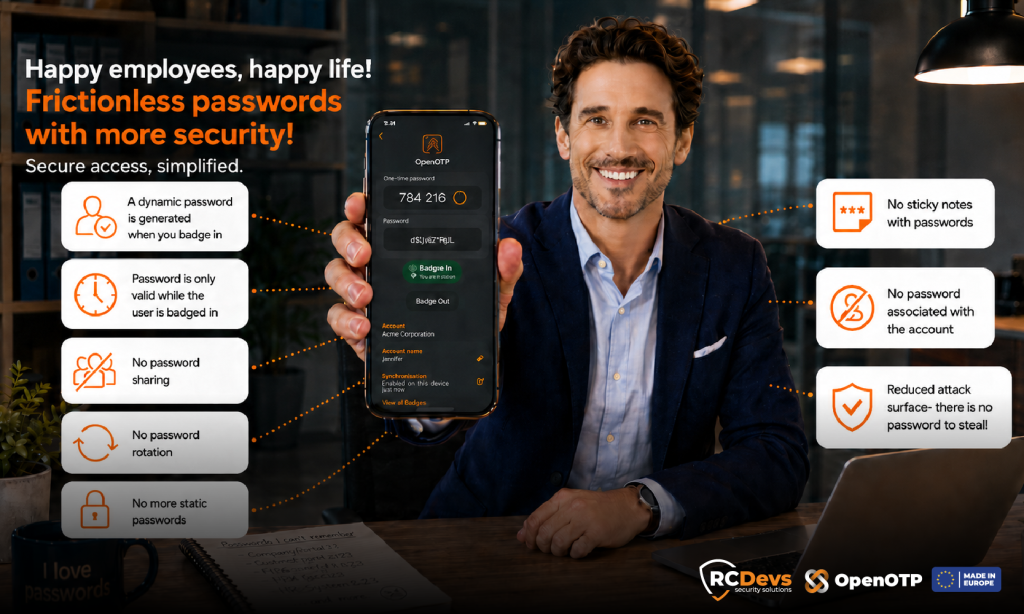
Even if someone somehow learns the password, it becomes useless the moment the employee leaves.
The result?
Password sharing becomes practically impossible.
Credential theft becomes dramatically less valuable.
Compliance requirements become significantly easier to satisfy.
Your Network Should Know You’re At Work
Why should a user manually badge if the network already knows they are present?
This is where the OpenOTP NAC integration becomes incredibly powerful.
Imagine an employee arriving at the office.
- Their phone or laptop connects to corporate Wi-Fi.
- The NAC authenticates the device.
- The user is automatically considered “badged in.”
- No additional action required.
- No extra workflow.
- No user friction.

The security posture adapts automatically because the network already verified the device and user.
This creates a frictionless user experience while simultaneously strengthening security.
One authentication event becomes a trigger for multiple security controls.
That’s smart security.
Security That Understands Location
Traditional MFA answers one question:
“Can you prove who you are?”
Modern threats require another question:
“Where are you?”
Location matters.
A lot.
A login from headquarters is different from a login from an airport.
A VPN connection from Luxembourg is different from one originating from a sanctioned region.
Badging introduces location (as well as other options) as a security factor.
Organizations can define:
- Approved countries
- Approved offices
- Approved zones
- Approved networks
When a user badges from an authorized location:
- Access can be granted immediately.
- When they badge from an unusual location:
- Additional verification can be required.
- Manager approval workflows can be triggered.
- Risk-based policies can be enforced automatically.
The security model becomes contextual rather than static.
Goodbye MFA Fatigue
Let’s talk about MFA.
MFA is essential.
Everyone should use it.
But users are tired of it.
Approve.
Approve.
Approve.
Approve.
Day after day.
Prompt after prompt.
Attackers have even started exploiting this through MFA fatigue attacks.
Users eventually click “Approve” simply to stop the notifications.
Security loses.
Productivity loses.
Everyone loses.
What if MFA could become intelligent?
With WebADM and OpenOTP, badging becomes an additional trust signal.
If a user is:
- Inside an approved building
- On an approved device
- Connected through an approved network
- Properly badged
Then repetitive MFA challenges can be reduced or eliminated.
Meanwhile, access to sensitive applications can still require stronger verification.
The result is adaptive MFA.
More security.
Less friction.
Better user experience.
Everyone wins.
The VPN Example That Changes Everything
Consider your VPN.
Today, many organizations ask:
“Does the user know their password?”
Maybe:
“Can they approve an MFA request?”
But imagine asking something much stronger:
- Is the user badged in?
- Are they on an approved device?
- Are they in an authorized location?
- Are they currently scheduled to be working?
- Is their risk profile acceptable?
Only if all conditions are satisfied does VPN access become available.
Suddenly, stolen credentials are no longer enough.
Stolen MFA is no longer enough.
Attackers must satisfy multiple real-world conditions simultaneously.
That is the essence of Zero Trust.
Windows Sessions That Follow Reality
Here’s another scenario.
An employee leaves the office.
They forget to lock their workstation.
Normally, that creates risk.
Now imagine the OpenOTP Mobile badging integrated directly with Windows.
The employee badges out.
Windows instantly:
- Locks the session
- Logs out the user
- Revokes credentials
- Updates security policies
The workstation automatically reflects reality.
The user is no longer present.
Therefore the session should no longer remain active.
Simple.
Logical.
Secure.
Dynamic LDAP Groups: Security That Evolves in Real Time
Traditional access management is static.
Administrators manually place users into groups.
Permissions remain unchanged for weeks, months, or years.
Badging allows group memberships to become dynamic.
When users enter specific facilities:
They can automatically join specific LDAP groups.
When they leave:
- They are automatically removed.
- Access rights follow real-world context.
- No tickets.
- No manual updates.
- No forgotten permissions.
- This significantly reduces excessive privilege accumulation.
One of the most common weaknesses in enterprise environments.
The Missing Layer in Zero Trust
The cybersecurity industry often talks about:
- Identity
- Devices
- Networks
But there is a fourth element that’s frequently ignored:
Presence.
Is the user actually where they claim to be?
Are they physically present?
Are they operating from a trusted environment?
Badging bridges the gap between physical security and digital security.
It combines:
- Identity
- Location
- Device trust
- Access control
- Contextual authentication
Into a single security framework.
This creates a far richer trust model than passwords and MFA alone could ever provide.
The Future of Authentication Is Context
Passwords alone are no longer enough.
Traditional MFA alone is no longer enough.
Even device trust alone is no longer enough.
The future belongs to adaptive authentication.
Authentication that understands:
- Who you are
- Where you are
- What device you use
- Whether you are actively working
- Whether your current context is trusted
By integrating badging with WebADM, OpenOTP, OpenOTP Token, NAC solutions, LDAP directories, Windows endpoints, and conditional access policies, organizations gain a completely new security control layer.
One that dramatically reduces attack surface while improving the user experience.
That’s a rare combination in cybersecurity.
Usually, stronger security means more friction.
Badging changes that equation.
For the first time, physical presence becomes a powerful cybersecurity signal.
And that changes everything.
Learn More
Discover how WebADM and OpenOTP transform badging from a simple attendance mechanism into a powerful adaptive security control: